
The Four Kurdish Officers: Martyrs of Mahabad and Symbols of a Nation
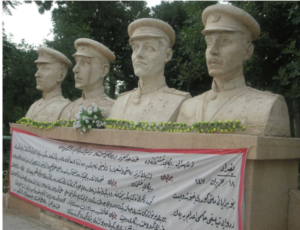
Photo Akram Naasan
Suleimanja 2005
By Daniel Dino
Middle East Security and Strategic Affairs Analyst
Afrin Times
In the history of the Kurdish people’s struggle for freedom and self-determination, there are events that are not merely painful chapters of the past but also milestones that shaped Kurdish national consciousness. One of the most significant of these events occurred on June 19, 1947, when four young Kurdish officers were executed by the Iraqi monarchy after being accused of supporting the Republic of Kurdistan in Mahabad.
The four officers—Mustafa Hushnaw, Khairallah Abdulkarim, Mohammed Mahmoud Qadsi, and Faik Hushnaw—were regarded as capable military professionals with a deep sense of national identity. They served in the Iraqi Army but chose to stand with their people when the Republic of Kurdistan was established in Mahabad in 1946 under the leadership of Qazi Muhammad.
The four officers left their official positions and joined the Kurdish national movement in Eastern Kurdistan. They helped build an organized military structure, trained Peshmerga fighters, and contributed to the establishment of the young republic’s security institutions. Their actions symbolized the national unity of the different parts of Kurdistan and the shared aspiration for freedom.
Following the fall of the Republic of Mahabad at the end of 1946 and the execution of Qazi Muhammad, the officers returned to Iraq. However, instead of receiving amnesty, they were arrested and brought before a military tribunal. Many Kurds viewed the proceedings as a political trial intended to deter any future efforts toward Kurdish national organization.
On June 19, 1947, the four men were executed at Baghdad’s Central Prison. According to historical accounts, they walked to the gallows with their heads held high, expressing loyalty to their people and to the Kurdish national cause. Their deaths quickly became a symbol of sacrifice, courage, and unwavering commitment.
Through these executions, the Iraqi authorities sought to suppress Kurdish national aspirations. Yet the outcome was quite the opposite. The memory of the four officers became a source of inspiration for generations of Kurdish activists, intellectuals, and Peshmerga fighters. Their story continues to be studied and remembered as one of the most powerful symbols of the Kurdish struggle during the twentieth century.
Even today, decades after the event, the story of the four officers remains a testament to the power of national ideals and to the willingness of individuals to sacrifice their lives for their beliefs. Their legacy reminds us that national struggles are measured not only by military victories but also by steadfastness in the face of persecution, hardship, and personal sacrifice.
May the memory of the four Kurdish officers remain forever engraved in the history of the Kurdish people and in the consciousness of future generations.